 Request Consultation




Disclaimer
The engagement was delivered in collaboration with Grassroots Public Affairs, combining project management, funding strategy, stakeholder coordination, and government relations expertise.
Introduction
We worked with an established Canadian value-added wood manufacturer preparing to expand its production capabilities and strengthen its long-term competitiveness.
Advance Lumber Remanufacturing Ltd. specializes in wood remanufacturing and precision services, including custom cutting, re-sawing, trimming, packaging, treatment, barcoding, and other value-added processes for industrial clients.
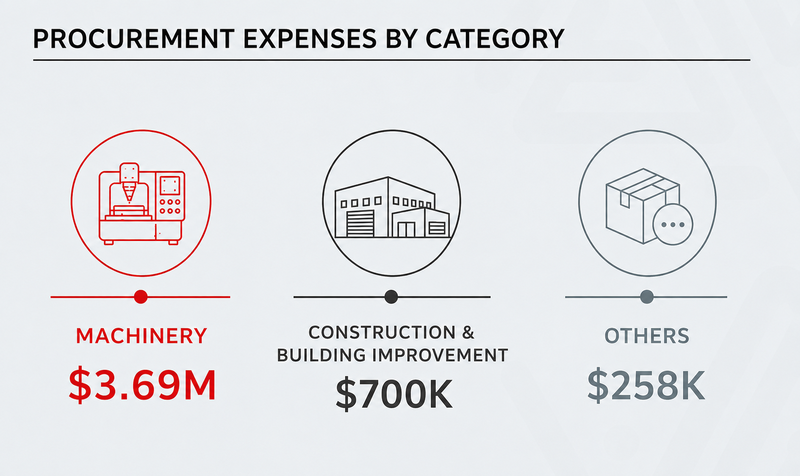
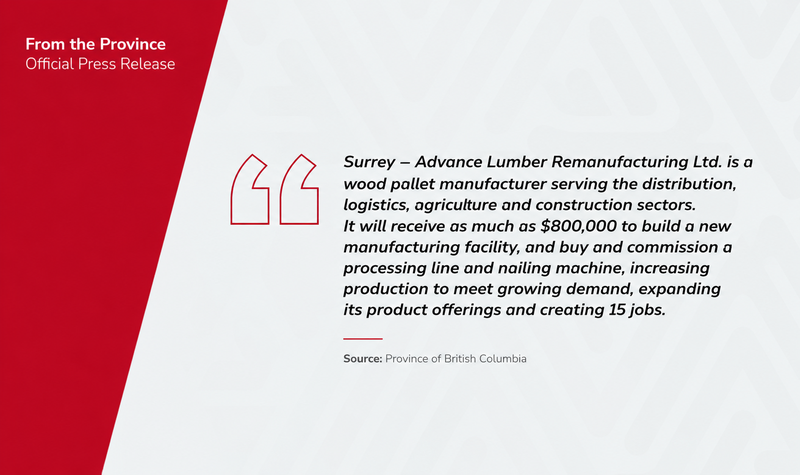
The proposed investment included a new manufacturing facility, an automated lumber-processing line, and an advanced pallet-nailing system. The expansion was designed to increase lumber-processing capacity from approximately 72,000 to more than 200,000 board feet per shift, substantially increase pallet production, and support new employment.
The project required significant capital investment and a detailed funding application supported by technical specifications, supplier quotations, financial projections, workforce planning, sustainability documentation, and evidence of industry demand.
Challenges
The planned expansion required more than funding. It required a structured investment strategy capable of demonstrating commercial viability, economic impact, and alignment with provincial manufacturing priorities.
The following challenges and desired improvements were identified:
Capital investment requirements
► Impact: The project involved automated manufacturing equipment, site improvements, electrical infrastructure, construction, and installation costs while the company continued managing its regular operations.
► Desired state: Government funding that would reduce the company’s upfront financial commitment and allow the expansion to proceed.
Complex application requirements
► Impact: The funding process required detailed financial, technical, operational, workforce, supplier, sustainability, and implementation information from multiple contributors.
► Desired state: A complete and consistent application supported by verifiable documentation and a clear investment rationale.
Demonstrating measurable impact
► Impact: The project needed to show that the investment would deliver more than equipment upgrades. It had to demonstrate increased production, job creation, product diversification, workforce development, and regional economic benefits.
► Desired state: A strong Business Case connecting the company’s commercial objectives with provincial manufacturing priorities.
Coordinating multiple stakeholders
► Impact: Required information was distributed across management, finance, operations, equipment suppliers, contractors, industry organizations, and government representatives.
► Desired state: One structured process for collecting, validating, integrating, and submitting all project information.
Solution
Following an assessment of the project scope and investment objectives, we determined that the BC Manufacturing Jobs Fund provided the strongest funding pathway for the expansion.
Working alongside Grassroots Public Affairs, we developed an integrated funding strategy that positioned the project around value-added manufacturing, automation, productivity, employment, sustainability, supply-chain resilience, and regional economic growth.
We coordinated the financial, operational, technical, workforce, and sustainability evidence required to demonstrate that the project was commercially viable, implementation-ready, and aligned with the program’s evaluation criteria.
The funding package also incorporated equipment specifications, production analyses, supplier quotations, facility requirements, financial projections, risk considerations, and letters of support from industry associations and established lumber suppliers. The supporting letters confirmed the project’s relevance to manufacturing capacity, low-grade lumber utilization, supply-chain continuity, and the broader value-added wood sector.
Implementation
Stage 1 – Project Assessment and Funding Alignment
We evaluated the proposed expansion against the Manufacturing Jobs Fund’s eligibility requirements and strategic priorities.
The assessment covered:
► capital investment and project costs;
► production and operational improvements;
► financial viability and expected return;
► workforce and economic impacts;
► sustainability and resource utilization;
► implementation risks and requirements.
This established the project’s core funding position and the evidence required for a competitive submission.
Stage 2 – Preliminary Project Submission
We prepared the initial submission outlining the company’s operations, project scope, planned equipment, expected manufacturing benefits, financial capacity, and alignment with provincial priorities.
The submission progressed successfully through the preliminary assessment, allowing the client to proceed to the detailed application stage.
Stage 3 – Business-Case and Evidence Development
Following preliminary approval, we coordinated a detailed information gathering process across the client’s management, finance, and operational teams.
We integrated:
► project budgets and financial statements;
► equipment quotations and technical specifications;
► production-capacity and ROI analyses;
► facility layouts and implementation requirements;
► employment, training, and economic-impact data;
► sustainability and industry-support documentation.
The resulting Business Case demonstrated the project’s commercial viability, manufacturing benefits, implementation readiness, and alignment with government priorities.
Stage 4 – Detailed Application and Government Review
We prepared and submitted the detailed application and supporting materials.
Throughout the review process, we:
► coordinated inputs from multiple contributors;
► reviewed documentation for accuracy and consistency;
► managed revisions and clarification requests;
► maintained alignment between technical and financial information;
► coordinated communications with program representatives.
Stage 5 – Funding Confirmation
The application was approved through the Manufacturing Jobs Fund, with government support covering 20% of eligible project costs.
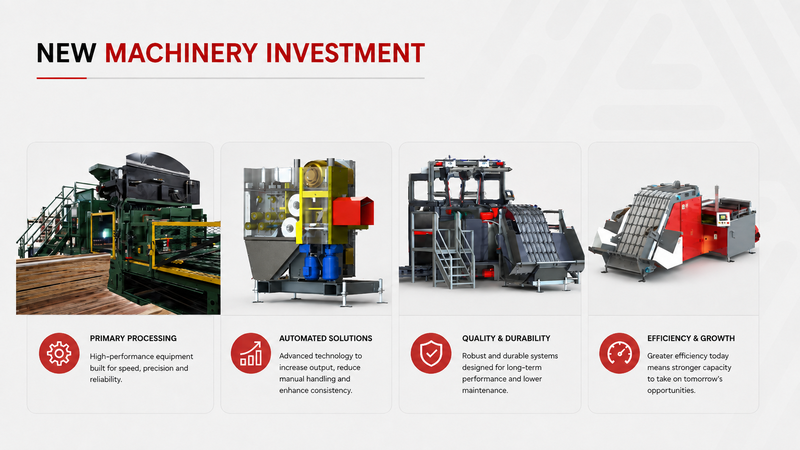
The approved project included the construction of a new manufacturing facility and the purchase and commissioning of an automated processing line and pallet-nailing machine.
Results
► Government funding secured: The client obtained Manufacturing Jobs Fund support covering 20% of eligible project costs, enabling the manufacturing expansion to proceed.
► Major capital expansion supported: The approved project included a new manufacturing facility, automated lumber-processing equipment, and an advanced pallet-nailing system.
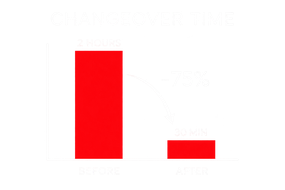
► Production capacity strengthened: The planned processing line was designed to increase output from approximately 72,000 to more than 200,000 board feet per shift, while the automated nailing system could produce approximately 2,500 to 3,000 pallets per shift.
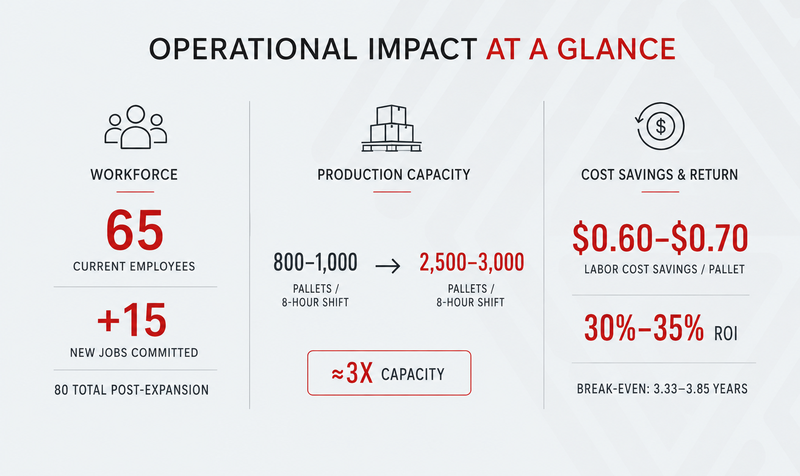
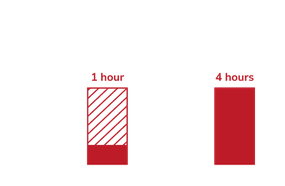
► Operational efficiency improved: Automation was expected to reduce manual production requirements, improve consistency, and shorten pallet-size changeovers from approximately two hours to 30 minutes.
► Employment growth supported: The publicly announced project was expected to create 15 new jobs in Surrey.
► Sustainability strengthened: The expansion supported greater use of low-grade lumber and aligned with the company’s zero-waste model, under which wood residuals and by-products are reused or repurposed.
► Comprehensive funding package delivered: Financial, operational, technical, workforce, sustainability, and economic-impact information was consolidated into one evidence-based Business Case.
► Government review coordinated: Communications, revisions, clarification requests, and supporting documentation were managed throughout the program’s assessment process.
The engagement converted a complex capital investment into an approved, evidence-based manufacturing expansion aligned with the client’s commercial objectives and British Columbia’s value-added manufacturing priorities.