 Request Consultation




Disclaimer
This success story has been anonymized to protect client confidentiality. Company and employee names, project locations, and sensitive operational details have been removed.
Introduction
We worked with a Canadian real estate and construction group managing several active development and renovation projects.
The company had grown faster than its internal operating structure. Project delivery depended heavily on individual knowledge, informal communication, and manual follow-up. Field teams, construction operations, procurement, accounting, and executives often worked from different information.
► project responsibilities were interpreted differently across teams;
► information moved inconsistently between the field and office;
► procurement, invoice approval, and expense tracking relied on manual processes;
► project data was distributed across several systems and personal folders;
► risks and operational issues were discussed but not maintained in one management register;
► recurring operational issues and unresolved dependencies were creating schedule pressure and increasing the need for management intervention.
Our assessment identified opportunities to strengthen governance, improve information flow, clarify accountability, and establish consistent project management controls across the organization.
The business case confirmed that the organization lacked formal project-management plans, a consistent roles-and-responsibilities structure, and reliable project controls. It also identified disconnected technology use, weak communication between field and office teams, and recurring operational conditions that affected schedule reliability and timely decision-making.
Challenges
Limited operational visibility
Project information was spread across project-management software, accounting systems, spreadsheets, email, and separate tracking boards.
This made it difficult to establish a reliable view of project status, costs, invoices, approvals, risks, and outstanding actions. Teams frequently had to request information manually or maintain duplicate records.
Unclear responsibility boundaries
Employees were often completing work outside their intended roles, while other responsibilities had no clear owner.
The problem affected procurement, scheduling, change orders, requests for information, submittals, invoice approvals, field coordination, and reporting. Existing organizational and RACI documents did not always reflect how work was actually being performed.
Delayed procurement and financial visibility
Purchase orders, change orders, receipts, and invoices passed through several people and systems before they could be reviewed or approved.
This created repeated administrative work and limited real-time visibility for construction operations and cost control.
Institutional knowledge concentrated within key personnel
Important processes relied on specific employees knowing what to do, who to contact, and where information was stored.
This created continuity risks when workloads changed, responsibilities shifted, or key personnel became unavailable.
Competing stakeholder priorities
Executives, construction operations, site teams, accounting, procurement, and property management viewed the same problems from different perspectives.
A solution required more than documenting procedures. It required identifying influence, resistance, information needs, and the appropriate level of engagement for each stakeholder group.
Solution
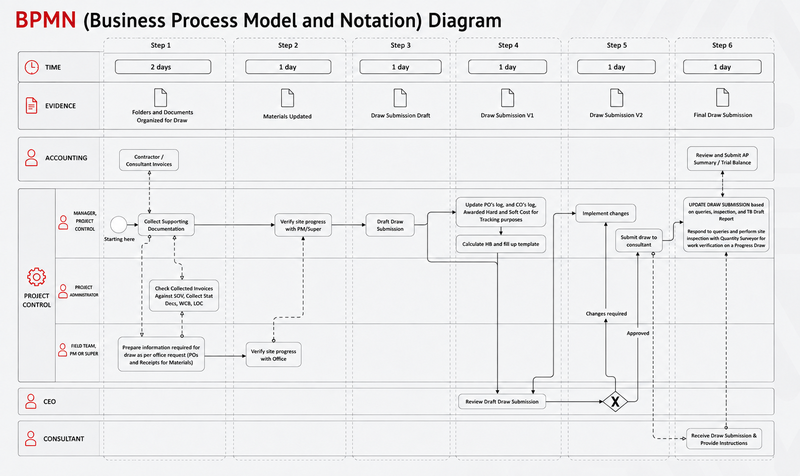
Rather than addressing isolated operational issues, the engagement focused on evaluating the organization's operating model to identify the structural improvements required for long-term operational efficiency and sustainable project delivery.
The objective was to establish a reliable view of how the organization worked, where delivery was breaking down, and which changes would create the greatest operational benefit.
Five core deliverables were developed:
► Operational Issue Register: A centralized management register documenting operational risks, improvement opportunities, supporting evidence, ownership, and recommended corrective actions.
Image idea – Statistics on problems vs solutions offered
► Stakeholder Map: An assessment of stakeholder influence, interest, current engagement, and required involvement.
► Roles and Responsibilities Analysis: A comparison of formal responsibilities, actual working practices, and gaps in accountability.
► Business Case: A structured assessment of the operational gaps, delivery impacts, organizational risks, and rationale for implementing the proposed changes.
► Implementation and Change Management Plan: A documented assessment of the current state, desired operating model, risks, recommendations, proposed controls, and implementation priorities.
Implementation
Stage 1 – Operational Investigation
We reviewed project records, schedules, organizational documents, procurement workflows, invoice processes, communications, and existing management tools.
Stakeholder interviews were used to compare written procedures with actual working practices. Particular attention was given to the points where work repeatedly slowed down, changed ownership, or required executive intervention.
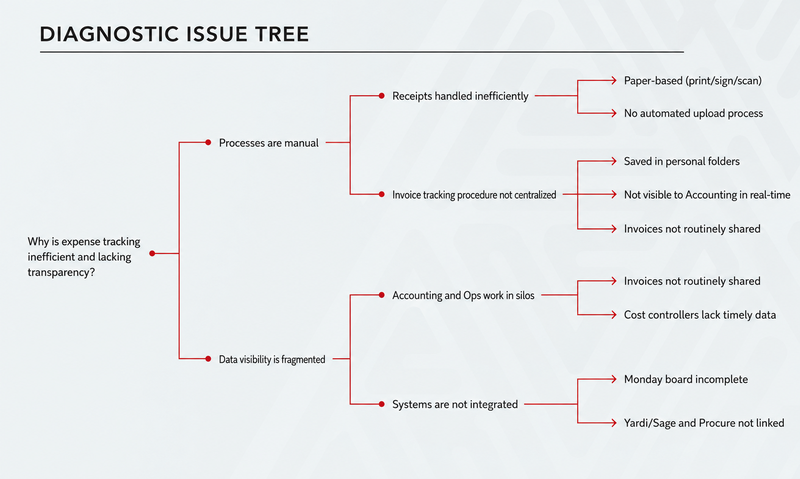
A diagnostic issue tree was developed to trace expense-tracking problems to their underlying causes. It showed that manual receipt handling, decentralized invoice storage, departmental silos, and disconnected systems were contributing to weak financial visibility.
Stage 2 – Issue Consolidation
We created a central Issue Log covering procurement, billing, scheduling, communication, role alignment, project documentation, resource allocation, design coordination, and information flow.
A total of 67 operational issues were documented, assigned corrective actions, and resolved during the engagement. Each issue was linked to its source, owner, supporting evidence, corrective action, and resolution status. This replaced scattered complaints and email discussions with a traceable management record.
Stage 3 – Stakeholder Analysis
We identified the stakeholders involved in construction operations, project delivery, finance, procurement, executive oversight, and property management.
They were assessed according to:
► organizational influence;
► level of interest;
► current support or resistance;
► required engagement;
► role in approving or implementing change.
This helped separate people who needed close involvement from those who required consultation, periodic updates, or monitoring.
Stage 4 – Responsibility and Governance Assessment
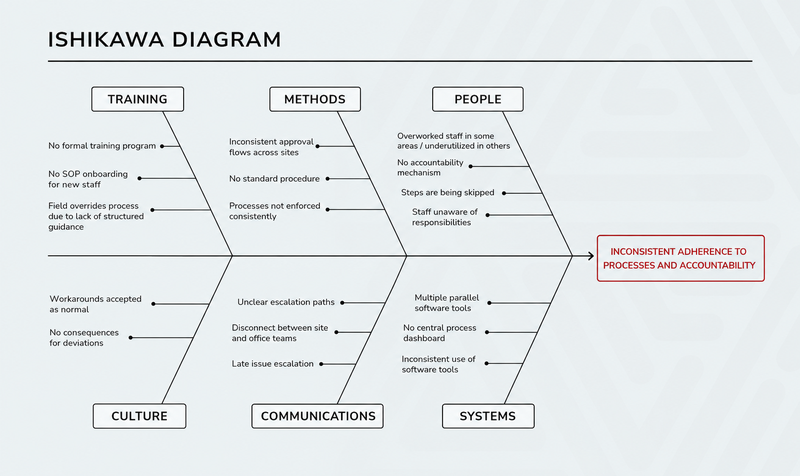
We compared the organizational chart, existing RACI documentation, employee feedback, and actual workflow behaviour.
The analysis covered responsibilities across procurement, scheduling, RFIs, submittals, site instructions, field coordination, change orders, risk reporting, billing, and project closeout. The construction RACI itself contained detailed responsibility assignments across these processes, but the investigation found gaps between documented accountability and day-to-day execution.
The resulting work identified:
► duplicated approvals;
► responsibilities assigned to the wrong organizational level;
► tasks without a clear accountable owner;
► excessive dependence on senior leadership;
► process gaps created by transitions between office and field teams.
The assessment also identified 12 team limitations affecting accountability, coordination, workflow continuity, and timely decision-making. These limitations were eliminated through clearer responsibility boundaries, revised workflows, and strengthened management controls.
Stage 5 – Implementation and Change Management Plan
The findings were consolidated into an Implementation and Change Management Plan outlining:
► the current operating environment;
► priority business processes requiring improvement;
► the proposed management structure;
► technology and information-flow requirements;
► implementation risks and limitations;
► initial performance measures;
► the recommended path toward a controlling PMO.
Risk responses were prioritized according to their operational and project-delivery impact. By the conclusion of the engagement, 80% of identified risks had been mitigated through clarified ownership, revised controls, improved information flow, and defined corrective actions.
The proposed measures included RFI and submittal response time, schedule deviation, time required to address issues, and the number of people involved in resolving each issue.
Results
The engagement converted fragmented operational information into a structured management system and produced measurable improvements across issue resolution, risk management, accountability, and project controls.
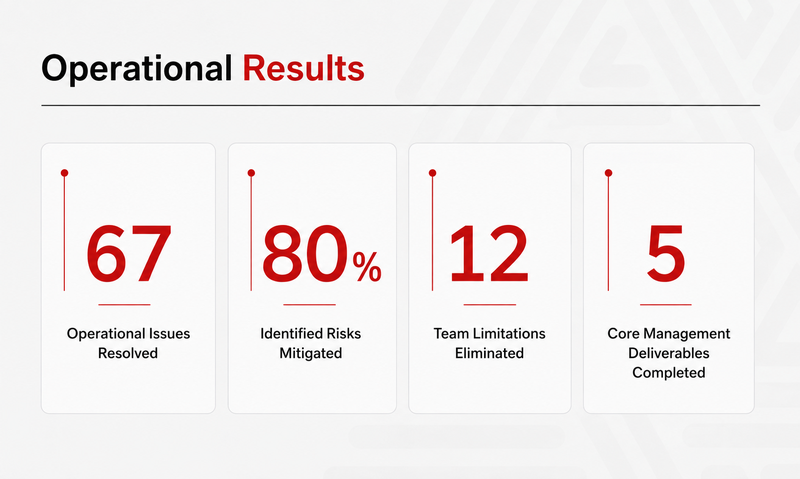
► 67 operational issues resolved: Issues affecting procurement, billing, scheduling, communication, documentation, resource allocation, design coordination, and information flow were documented, assigned corrective actions, and resolved.
► 80% of identified risks mitigated: Priority operational and project-delivery risks were reduced through clarified ownership, revised controls, improved information flow, and structured corrective actions.
► 12 team limitations eliminated: Constraints affecting accountability, coordination, decision-making, and workflow continuity were addressed through responsibility clarification and process improvement.
► Governance and responsibilities strengthened: Responsibilities were analyzed across major construction and administrative processes, reducing duplicated effort, unclear ownership, and excessive dependence on senior leadership.
► Core management deliverables completed: The Issue Log, Stakeholder Map, Roles and Responsibilities Analysis, Business Case, and Implementation and Change Management Plan were delivered.
► Implementation roadmap established: Management received a practical roadmap for improving reporting, standardizing processes, strengthening project controls, and progressing toward a future Controlling PMO.
The engagement restored operational control by resolving recurring issues, reducing risk exposure, clarifying accountability, and establishing the management structure required to improve project delivery and schedule reliability.