 Request Consultation




DISCLAIMER
This success story has been sanitized and anonymized to protect client confidentiality. Client names, proprietary business information, financial data, and commercially sensitive details have been omitted or generalized. This portfolio summary reflects the scope of work and experience gained across multiple startup engagements delivered by Chaplynsky Corp.
INTRODUCTION
Developing a startup requires much more than an innovative idea. Founders must simultaneously validate their business model, establish operational foundations, secure funding, protect intellectual property, coordinate technical development, and prepare for commercialization, all while working with limited resources and tight timelines.
Chaplynsky Corp. supported startup companies across multiple industries by combining strategic advisory with external project management. Our engagements range from helping founders transform early-stage concepts into operational businesses to providing execution support for established startups facing critical operational, commercial, or organizational challenges.
Across 76 startup engagements, we developed 36 ventures from the initial concept through funding and launch, while supporting 40 additional startups that required strategic, operational, or project-delivery intervention. Of the 36 startups developed from scratch, 35 were accepted into a startup incubator and received funding, representing a 97% funding success rate.
Unlike traditional consulting engagements focused on a single business function, startup development required the simultaneous coordination of strategy, commercialization, funding, intellectual property, operations, and project delivery within one integrated management framework.
CHALLENGES
Although every startup is unique, most founders encountered similar obstacles during their growth journey.
► Developing investment-ready businesses
Many founders possessed strong technical ideas but required structured business planning, financial modelling, and documentation to meet investor, funding, and regulatory expectations.
► Protecting innovation
As products matured, startups needed to identify and protect patents, trademarks, proprietary methods, and other intellectual assets that supported long-term commercialization.
► Moving from concept to execution
Transforming innovative ideas into viable businesses required coordinated planning across product development, operations, funding, branding, and commercialization.
► Limited internal capacity
Growing companies often lacked the resources to manage multiple workstreams simultaneously, creating delivery risks during critical stages of development.
► Recovering underperforming startup projects
Some engagements began after development was already underway and required corrective action to resolve weaknesses in strategy, documentation, funding readiness, execution, or stakeholder coordination.
INDUSTRIES SUPPORTED
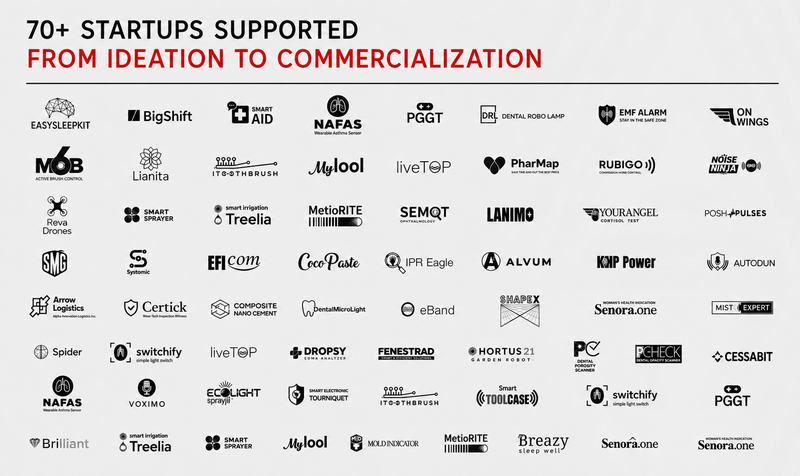
Health & Medical Technology
Startups developing innovative medical and wellness solutions — from disease monitoring systems and asthma detection devices to wearable tools that improve patient diagnostics and care. These ventures focus on enhancing healthcare accessibility, early detection, and personalized treatment through data-driven innovation.
Smart Wearables & Connected Devices
Entrepreneurs creating intelligent products that combine hardware and software — such as smart watches and glasses capable of detecting pain or tracking physiological signals. These technologies bridge everyday use with medical-grade precision, supporting both consumer health and lifestyle improvement.
Professional & Industrial Equipment Innovation
Companies designing specialized equipment for professional use, including advanced tools and devices for dental clinics and other technical fields. These startups blend ergonomic design, safety, and efficiency to help practitioners deliver higher-quality results.
Emerging Tech & Applied Innovation
Startups exploring the frontier between sectors — integrating AI, IoT, and sensor-based systems to create solutions that redefine how industries approach monitoring, data collection, and automation. This group represents multi-sector innovation where technology meets real-world problem-solving.
SOLUTION
Chaplynsky Corp. acted as both a strategic advisor and an external project management partner, integrating business planning, commercialization, intellectual property support, and execution into a single coordinated engagement.
Rather than providing isolated consulting services, we developed structured delivery programs tailored to each startup's stage of growth, technical maturity, funding objectives, and commercial priorities. Depending on the engagement, this included refining business concepts, preparing investment-ready documentation, coordinating intellectual property activities, supporting commercialization, and coordinating the execution of critical business initiatives.
For startups developed from scratch, we managed the complete path from concept validation and business planning through incubator approval, funding, and launch. For inherited projects, we assessed the existing work, identified weaknesses, and implemented targeted corrective actions to improve their probability of approval and successful delivery.
Our role extended beyond advisory services. We coordinated stakeholders, managed priorities, monitored progress, and either led the complete startup-development process or recovered projects that were already experiencing strategic and delivery challenges.
IMPLEMENTATION
Our work followed a structured process focused on clarity, scalability, and protection:
Stage 1 — Venture Assessment
We evaluated each startup's business objectives, technical maturity, commercial potential, available resources, and operational challenges to establish a practical development strategy.
For inherited engagements, the assessment also included a review of existing business plans, applications, financial models, technical materials, and project status. This allowed us to identify the issues limiting approval or execution and establish a corrective action plan.
Stage 2 — Business Development
Business concepts were refined through structured planning, commercialization support, market analysis, and business model development to establish a viable path toward funding and market entry.
Stage 3 — Documentation and Investment Readiness
Investor presentations, business plans, financial projections, technical documentation, commercialization strategies, and supporting materials were developed or corrected to strengthen incubator eligibility, funding readiness, and stakeholder engagement.
Stage 4 — Intellectual Property Support
We coordinated intellectual property activities, including patent and trademark support, while helping founders identify, organize, and document the intellectual assets underpinning their businesses.
Stage 5 — Strategic Project Management
Throughout implementation, Chaplynsky Corp. provided external project management, coordinating workstreams, stakeholders, timelines, and deliverables while supporting founders through commercialization and organizational growth.
For inherited projects, progress was monitored against the corrective action plan until the identified funding, documentation, or execution gaps were resolved.
RESULTS
Across 76 startup engagements, Chaplynsky Corp. combined end-to-end venture development with targeted project recovery, improving funding readiness, execution, and commercialization outcomes.
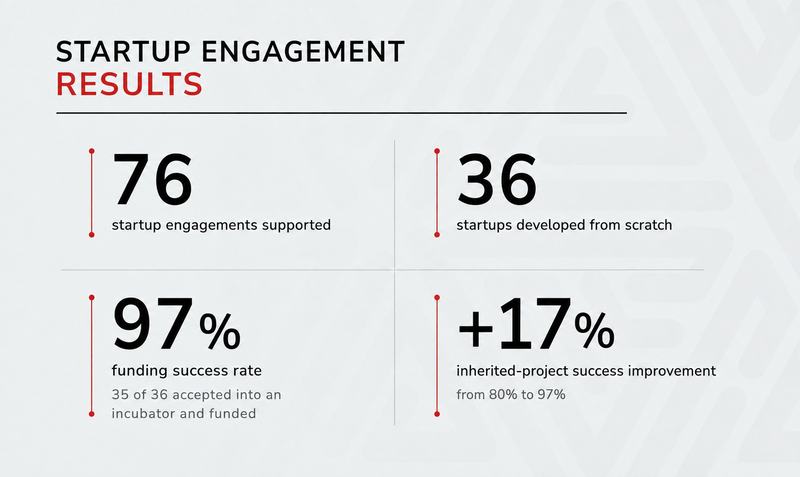
► 76 startups supported: The portfolio included ventures developed from the initial concept as well as existing projects requiring strategic, operational, or project-management intervention.
► 36 startups developed from scratch: We led these ventures through concept development, business planning, incubator preparation, funding, commercialization, and operational launch.
► 97% funding success rate achieved: Thirty-five of the 36 startups developed from scratch were accepted into a startup incubator and received funding.
► Inherited-project success increased by 17% points: Corrective strategic and project-management support increased the success rate for startups received after initiation from 80% to 97%.
► Investment readiness strengthened: Business plans, financial models, technical materials, commercialization strategies, and funding documentation were developed or corrected to meet incubator and stakeholder requirements.
► Intellectual property and execution supported: Patent and trademark activities, stakeholder coordination, priorities, timelines, and deliverables were managed throughout development and commercialization.